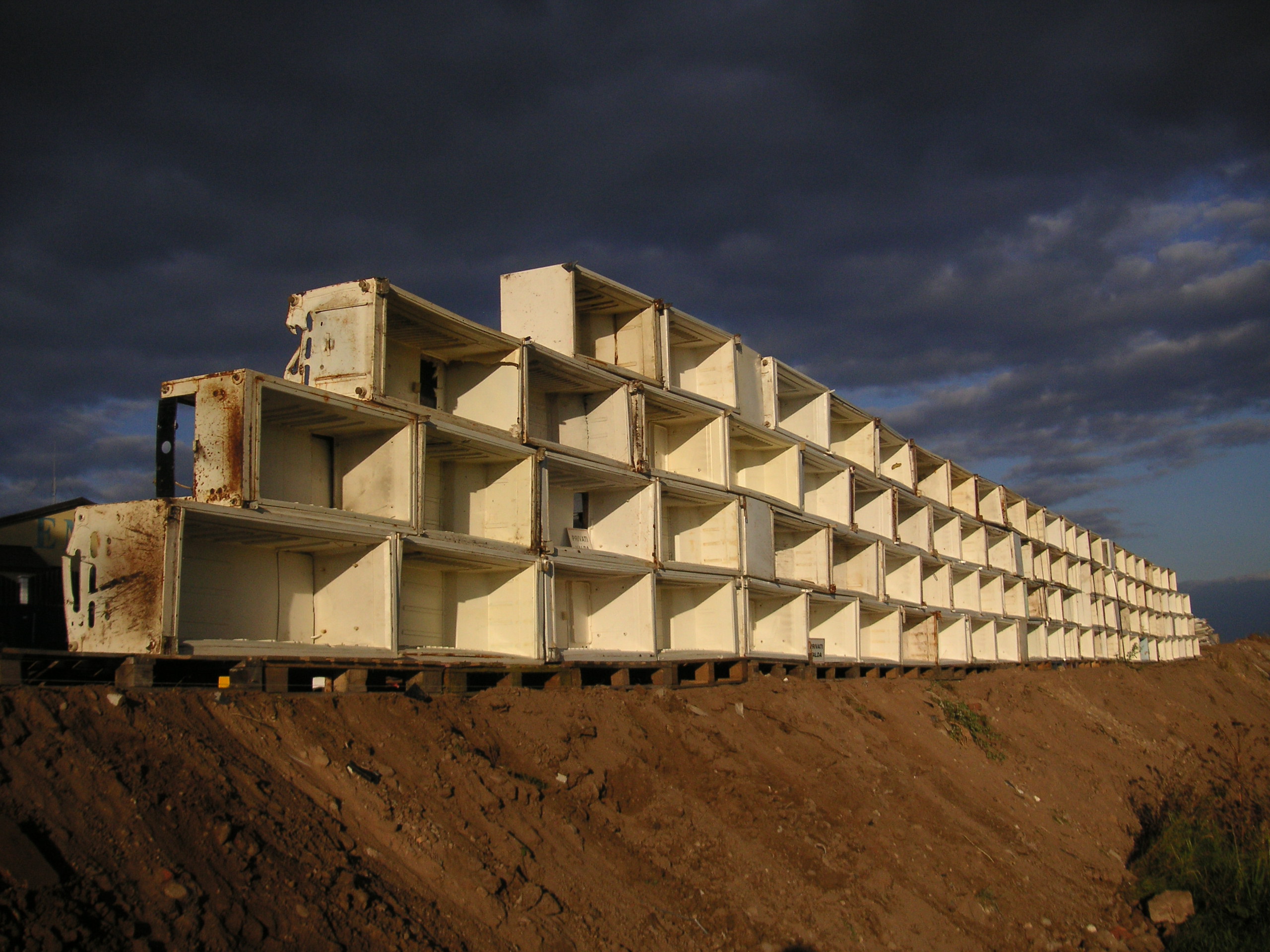
Saldytuvų Siena
“What is it?” asked the highway inspector. “It’s art,” said the director of the fridge recycling company. “Ok!” said the inspector.
When constructing large temporary installations, consider they may persist beyond their planned duration. This wall of discarded refrigerators, intended as a three-month intervention, functioned for four years as a temporary parking facility for the factory’s resource stream. The white enameled boxes stacked in grid formation created both storage infrastructure and inadvertent viewing frames, landscape windows where doors once sealed cooling compartments. At night, the installation’s green signage identified its function. The structure served simultaneously as public installation and industrial buffer until materials continued their journey through the recycling system. A reminder that “temporary” remains negotiable when waste streams require interim storage.
The Lithuanian recycling company EMP had mountains of fridges to be recycled in front of their refrigerator recycling plant. The idea was to give the factory a positive visual connection with the Lithuanian landscape and the passing highway. It was more than logical to use semi-recycled fridges (no cooling fluids, no electrics) as a building material, because it was available onsite. We used 800 fridges to build the 3dimensional wall with windows and a balcony to the surrounding nature. After finishing the construction works we illuminated a chosen amount of fridges creating the so-called ‘Frixel’, a hybrid of fridge and pixel.
dimensions: length 100m, height 4 m
material: one way plastic pallets and cable ties
construction type: brick layout stacking with steel wrap ties
lights: colour tlc